
1.Purpose of the Productive and Reliable Telecommunications Network for Radio Stations (PARTNER)
What is the Productive and Reliable Telecommunications Network for Radio Stations (PARTNER)?
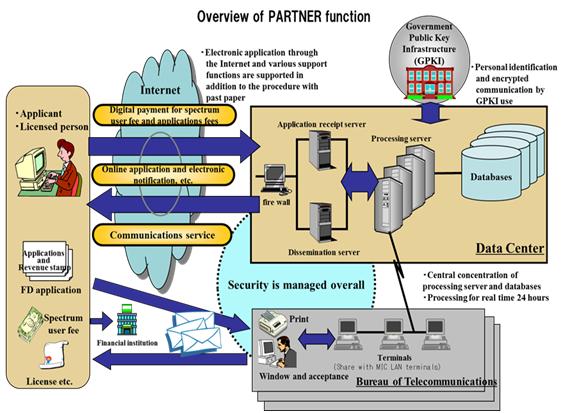
The PARTNER system is a computer system with a database of all the licensed radio stations that can support speedy and efficient execution of radio administrative work such as processing of license applications for radio stations, radio monitoring and frequency management. The system went into operation in April 1996.
The system has been built with 3 main objectives in mind as follows:
- Improvement of the efficiency of radio administration work;
- Improving of services to the license holders of radio stations;
- Support of radio policy planning.
2.Outline of PARTNER
- Development plan
The development of the PARTNER system over six terms thus far, and the development plan for the current seventh term are as follows.Phase I
(FY1993-1995)- Development of eight processing functions, including the processing of radio station applications, supporting radio monitoring, and collecting spectrum user fees
- April 1996 launch
Phase II
(FY1996-1998)- Expansion of functions from Phase I
- Development of FD application functions
- Electronic approval of radio station licensing process, etc.
- Development of electronic public disclosure system via the Internet, etc.
Phase III
(FY2000-2001)- Enhancing electronic approval functions
- Tightening security measures
- Introduction of mobile computing functions
- Expansion of service support and search functions
Phase IV
(FY2002-2004)- Constructing an online application system
- Development of a digital payment function for spectrum user fee and application fees
- Development of policy assistance functions
- Development of future systems (Web computing, central processing, real-time processing, etc.)
Phase V
(FY2005-2007)- Development of intelligent application and approval assistance functions
- Enhancement of security functions
- Enhancement of service processing functions
Phase VI
(FY2008-2010)- Introduction of an electronic application system (for amateur stations) employing an ID and password system
- Introduction of a virtualization platform
- Development of support technology for radio station information input
- Conversion of terminals to thin-client
Phase Ⅶ
(FY2011-2013)- Updating of base hardware
- Improvement of system in line with legal revisions
- Improvement of usability
- Plan for work/system optimization of radio monitoring work
The June 14, 2004 partial revision of the e-Government Creation Plan called for the formation of a work and system optimization plan as soon as possible and no later than the end of FY2005, based on the Guidelines for Work/System Optimization Plan Formation, Version 2 (decided by the Liaison Conference of Chief Information Officers of each ministry on February 10, 2004).
Accordingly, each ministry formated policies for work and system revision, consisting of basic optimization principles and specific reforms, no later than June 2005 in preparation for finalization of optimization plans, and has worked to optimize and streamline work and systems. With this in mind, MIC has formated a revised policy clearly outlining reforms such as improvement of work efficiency and consolidation and centralization of external contracts and systems related to radio monitoring work, including PARTNER. - Outline of processing functions
The main processing functions of PARTNER are as follows:(1) Radio station application processing The services concerned with permission and authorization of radio stations by the use of database of all the radio stations (acceptance of applications, examination, preparation of licenses, etc.) (2) Collection of spectrum user fees The services concerned with collection of spectrum user fee (accrual management of loans receivable, issuance of notices of payment, registration of receipts, etc) (3) Supervision of radio stations Radio station inspections (Formulation of plans, notification of inspections, etc.) (4) Spectrum management Spectrum management (monitoring of spectrum utilization status, etc.) (5) Prevention of anomalous radio propagation Designation of areas for prevention of anomalous radio propagation, and judgment of anomalies. (6) Technical computation Investigations of interference, propagation routes, etc. (7) Radio station statistics Management of statistical data on number of radio stations, analysis of data, etc. (8) Provision of information in electronic format Provision of information on radio use procedures, etc. - Effects of introduction of PARTNER
- Speeding up of license application processing
With the increase in the number of radio stations, there has been an increasing workload, such as in the office work for processing license applications and for consideration and prevention of interference. Office automation has been introduced to prevent increases in the time required for processing.
On-line applications have been introduced to improve user-friendliness and simplify and speed up application procedures, as well as for further improvement of administrative services. - Promotion of effective use of frequencies
By computerizing radio station databases and automating processes, the status of frequency usage can be grasped quickly, and frequencies can be assigned more efficiently.
In addition, better radio wave environments can be created, as the databases enable smooth performance of radio monitoring work. - Promotion of information disclosure
Procedures for using radio spectrum are disclosed in order to expand
utilization opportunities for users, and by offering a searchable database of radio station information, it is possible to meet user demands for greater transparency in the administration of radio waves. When users seek to use radio spectrum, it is possible to determine in advance whether a certain frequency is usable. User needs are reflected in the administration of radio stations.
- Speeding up of license application processing
3.Change in PARTNER budget
| Change in PARTNER budget (unit: million yen) | ||||||||||||
|---|---|---|---|---|---|---|---|---|---|---|---|---|
| Item | MIC | Regional stations | Total | |||||||||
| System development expenses | Calculator rental fees | Contracted operation fees | Dedicated telecommunications line costs | Land, building and rental costs | Equipment and facilities costs | Other (utilities, etc.) | Sub total | Contracted operation fees (note) | Other (utilities, etc.) | Sub total | ||
| FY 1993 | 1,026 | 0 | 0 | 7 | 6 | 51 | 36 | 1,126 | 0 | 846 | 846 | 1,972 |
| FY 1994 | 1,161 | 0 | 0 | 9 | 18 | 338 | 91 | 1,617 | 0 | 691 | 691 | 2,308 |
| FY 1995 | 862 | 719 | 11 | 36 | 12 | 568 | 138 | 2,346 | 37 | 1,210 | 1,247 | 3,593 |
| FY 1996 | 1,562 | 1,717 | 44 | 38 | 12 | 148 | 249 | 3,770 | 284 | 556 | 840 | 4,610 |
| FY 1997 | 1,601 | 2,998 | 45 | 31 | 12 | 0 | 538 | 5,225 | 290 | 533 | 823 | 6,048 |
| FY 1998 | 3,161 | 3,587 | 59 | 68 | 12 | 66 | 426 | 7,379 | 290 | 493 | 783 | 8,162 |
| FY 1999 | 2,137 | 3,752 | 73 | 68 | 12 | 0 | 277 | 6,319 | 290 | 482 | 772 | 7,091 |
| FY 2000 | 4,345 | 3,770 | 89 | 97 | 49 | 1,011 | 849 | 10,210 | 299 | 475 | 774 | 10,984 |
| FY 2001 | 4,693 | 3,560 | 83 | 94 | 74 | 0 | 1,943 | 10,447 | 295 | 471 | 766 | 11,213 |
| FY 2002 | 4,540 | 5,014 | 111 | 167 | 200 | 0 | 568 | 10,600 | 295 | 463 | 758 | 11,358 |
| FY 2003 | 5,923 | 5,097 | 398 | 140 | 173 | 0 | 482 | 12,213 | 0 | 439 | 439 | 12,652 |
| FY 2004 | 5,394 | 5,227 | 411 | 206 | 270 | 0 | 1,087 | 12,595 | 0 | 400 | 400 | 12,995 |
| FY 2005 | 2,896 | 4,514 | 468 | 181 | 288 | 0 | 753 | 9,100 | 0 | 367 | 367 | 9,467 |
| FY 2006 | 3,389 | 3,745 | 496 | 172 | 251 | 0 | 346 | 8,399 | 0 | 171 | 171 | 8,570 |
| FY 2007 | 3,334 | 3,453 | 440 | 114 | 235 | 0 | 318 | 7,894 | 0 | 171 | 171 | 8,065 |
| FY 2008 | 3,154 | 2,872 | 438 | 106 | 235 | 0 | 395 | 7,200 | 0 | 81 | 81 | 7,281 |
| FY 2009 | 2,158 | 2,824 | 431 | 106 | 184 | 0 | 363 | 6,066 | 0 | 15 | 15 | 6,081 |
| FY 2010 | 2,014 | 2,818 | 431 | 119 | 188 | 0 | 373 | 5,943 | 0 | 16 | 16 | 5,959 |
| FY 2011 | 1,987 | 2,740 | 431 | 145 | 206 | 0 | 266 | 5,775 | 0 | 15 | 15 | 5,790 |
(Note) Contracted operation of regional bureau is converted to MIC budget from FY2002 onward
4.Plan for improvement of PARTNER usability
At the 37th Liaison Conference of Chief Information Officers of each ministry which took place in July 2009, e-Government Usability Guidelines were drawn up.
These guidelines cover 71 key governmental online application systems stipulated in the Action Plan for Expansion of Online Service Utilization (Sept. 2008, IT Policy Headquarters), which are to have usability improvement plans prepared and released within FY2010 or so. PARTNER is among the systems covered.
The usability improvement plan outlines plans for the MIC "Radio Use Electronic Application and Notification System Lite" geared toward amateur stations, and calls for progressive implementation of measures to boost the user-friendliness of the system.