
1.About the Radio Propagation Blockage Prevented Area
It's quite common to see a saucer-shaped antenna atop a building or tower nowadays, and these saucer-shaped antennas are used in two different ways. Those pointing upwards to the sky are used for satellite telecommunications. The others are used as fixed micro telecommunications antennas, as shown in a lower figure.
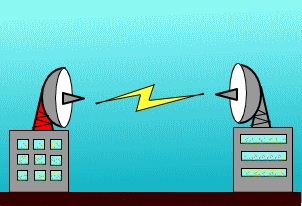
In flat areas, the radio waves of these stationary micro lines are directed in parallel to the land surface, and any buildings that are erected in the radio wave path (transmission route) will obstruct telecommunications. (See a lower figure)
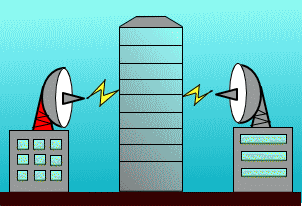
This is why any new building plans for high rise buildings (buildings 31 m or more above ground) must be examined with a figure, which is provided by the Ministry of Internal Affairs and Communications and shows the radio propagation blockage prevented area, to ensure that if it will not block transmission lines.
If the high-rise building is in the transmission line path, the building location, height, shape, and other details must be submitted to the Regional Bureau of Telecommunications prior to construction .
The above-mentioned figure for examination can be found at the Regional Bureau of Telecommunications, the related local public offices, and other organizations.
The micro telecommunications specified in the radio interference prevention area, and the related legal restraints, are as follows.
2.Target of the Law
Important Radio Communications
What are Important Radio Communications?
→ Radio communications to be executed on frequencies of 890 MHz or above between specific fixed points which fall under any of the following items (Radio Law Article 102-2 (1)).
- Radio communications by means of radio equipment in a radio station devoted to telecommunications service.
- Radio communications by means of radio equipment in a radio station devoted to broadcast service.
- Radio communications by means of radio equipment devoted to service for the purpose of protecting lives or property or of maintaining public peace and order.
- Radio communications by means of radio equipment devoted to meteorological service.
- Radio communications by means of radio equipment devoted to electric power supply activities for the electricity business.
- Radio communications by means of radio equipment devoted to the operation of trains for the railway business.
3.Effects of the Law
Notification of Construction of Tall Buildings and Structures
Any building owner who plans to construct a building that is higher than 31 meters, within a radio propagation blockage prevented area, must notify the Minister for Internal Affairs and Communications in writing, prior to initiating the specified construction, of the particulars of the structure, including the location, height, and other necessary information (Radio Law 102-3 (1)).
Restriction on Work of Upper Part to Cause Important Radio Communications Hindrance
A building owner who has been notified by radio administrative authorities that the building causes a radio communications hindrance shall not conduct construction work related to the part causing hindrance for a period of two years (or three years in case of the radio propagation blockage prevented area for telecommunications service) from the day of being notified, unless the building owner has modified the plan of the specified construction work and has been notified that the building causes no important radio communications hindrance over the radio propagation blockage prevented area, or when a building owner has come to an agreement with the licensee (Radio Law 102-6).
4.Specified Areas
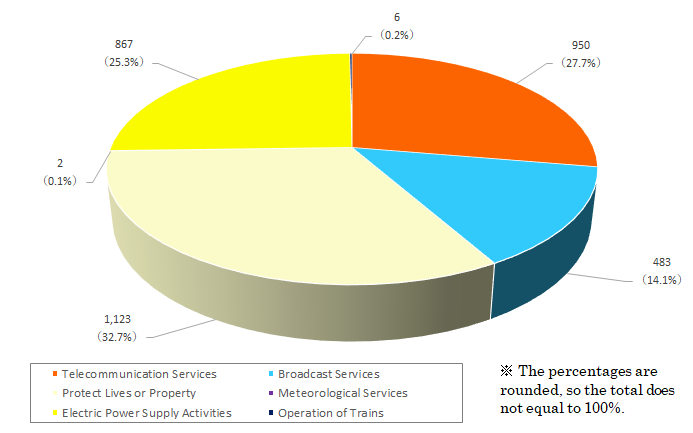
| Type of Important Radio Communications | Specified Areas as of March, 2023 | Ratio (%) |
|---|---|---|
| For Telecommunication Services | 950 | 27.7 |
| For Broadcast Services | 483 | 14.1 |
| To Protect Lives or Property or for Maintaining Public Peace and Order | 1,123 | 32.7 |
| For Meteorological Services | 2 | 0.1 |
| For Electric Power Supply Activities | 867 | 25.3 |
| For the Operation of Trains | 6 | 0.2 |
| Total | 3,431 | 100.0 |